
L'essentiel
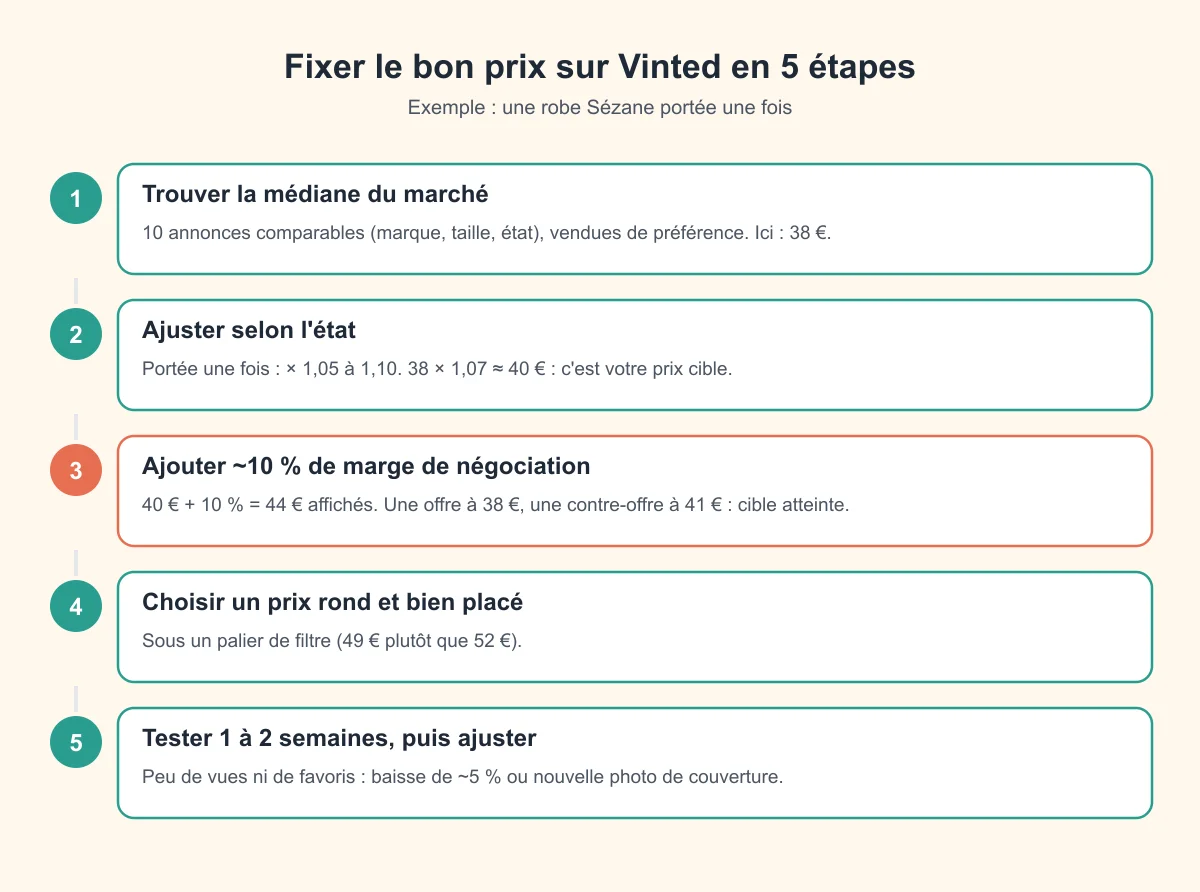
Pour fixer le bon prix sur Vinted, partez du prix médian d’une dizaine d’articles comparables (même marque, taille et état, vendus de préférence), ajustez-le selon l’état réel du vôtre, puis ajoutez environ 10 % de marge de négociation. Bien fixer son prix ne veut pas dire brader : c’est afficher un prix que le marché accepte, avec de quoi répondre aux offres sans descendre sous votre objectif. Votre prix est aussi un critère que Vinted cite pour classer les annonces dans la recherche.
Pour la manipulation dans l’application (« où cliquer pour modifier »), voir Modifier le prix d’un article. Pour la gestion des offres reçues, voir Bien négocier sur Vinted en tant que vendeur. Ici, on parle stratégie de prix.
Étape 1 : trouver le prix du marché
Le seul vrai repère est le prix auquel des articles réellement comparables au vôtre se vendent. Méthode :
- Sur Vinted, recherchez la marque + type d’article + taille (« robe Sézane 36 »).
- Affinez avec les filtres d’état et, si besoin, de couleur ou de matière.
- Relevez une dizaine de prix d’annonces vraiment comparables (même modèle ou équivalent, même état).
- Complétez avec des articles déjà vendus : sur de nombreux dressings, les ventes passées restent visibles avec la mention « Vendu », ce qui donne une idée des prix effectivement acceptés.
- Retenez le prix médian (celui du milieu quand vous les classez du moins cher au plus cher) : c’est votre référence, moins sensible aux annonces extrêmes qu’une moyenne.
Le comparateur de prix Vinted, gratuit, vous aide à structurer cette comparaison.
Attention aux annonces en ligne depuis des mois à un prix élevé : elles montrent ce que certains vendeurs espèrent, pas ce que les acheteurs paient.
Étape 2 : ajuster selon l’état
Votre article n’est jamais le clone parfait des annonces comparables. Ajustez votre référence selon son état réel. Les coefficients ci-dessous sont des repères indicatifs, à moduler selon la marque et la demande :
| État réel | Ajustement indicatif par rapport à la médiane |
|---|---|
| Neuf avec étiquette | × 1,20 à 1,30 |
| Neuf sans étiquette / porté 1-2 fois | × 1,05 à 1,10 |
| Très bon état | × 0,95 à 1,00 |
| Bon état | × 0,80 à 0,85 |
| Satisfaisant (porté souvent) | × 0,65 à 0,75 |
Exemple : la médiane des robes Sézane comparables est de 38 €. Votre robe a été portée une fois : 38 × 1,07 ≈ 40,60 €. Vous visez 40 €.
Étape 3 : ajouter une marge de négociation
La négociation fait partie des usages de Vinted : beaucoup d’acheteurs envoient une offre plutôt que d’acheter au prix affiché. Si vous affichez directement votre prix cible, vous devrez soit accepter moins, soit refuser et risquer de perdre la vente.
Les acheteurs peuvent proposer jusqu’à 40 % sous votre prix (aide Vinted), mais rien ne vous oblige à accepter. Ajoutez environ 8 à 12 % à votre prix cible pour absorber une négociation raisonnable sans descendre sous votre objectif.
Reprise de l’exemple : 40 € + 10 % = 44 € affichés. L’acheteur propose 38 €, vous faites une contre-proposition à 41 € ou acceptez 40 € : vous atteignez votre cible.
Ce que paie vraiment l’acheteur
Votre prix n’est pas le total de l’acheteur : il paie en plus les frais Vinted (en général 5 % du prix + 0,70 €, selon la grille officielle) et le port. Vous, vendeur particulier, touchez le prix de vente intégral.
| Prix affiché | Frais Vinted payés par l’acheteur | Total hors port | Vous touchez |
|---|---|---|---|
| 10 € | 1,20 € | 11,20 € | 10 € |
| 25 € | 1,95 € | 26,95 € | 25 € |
| 44 € | 2,90 € | 46,90 € | 44 € |
Sur les petits articles, ces frais pèsent lourd dans la décision : c’est l’argument pour proposer des lots. Le calculateur de frais Vinted fait le calcul pour n’importe quel prix.
Étape 4 : choisir un prix « rond » et lisible
Sur les petits prix, un chiffre rond (10 €, 15 €, 20 €) est simple à lire et laisse de la place à la négociation. Les prix en ,99 sont moins utiles sur une plateforme entre particuliers où presque tout se négocie. Au-delà de 50 €, des paliers ronds ou intermédiaires (45 €, 48 €, 50 €) restent lisibles.
Pensez aussi aux tranches de prix utilisées dans les filtres de recherche : un article à 49 € apparaîtra pour les acheteurs qui filtrent « jusqu’à 50 € », pas un article à 52 €.
Étape 5 : tester, ajuster et savoir baisser
Donnez une à deux semaines à votre annonce. Si elle n’a presque pas de vues ni de favoris, le prix (ou la première photo) n’accroche pas. Trois options :
- Baisser le prix d’environ 5 % : une baisse de prix peut être signalée aux membres qui ont mis l’article en favori.
- Faire remonter l’annonce : voir republier un article Vinted en 1 clic.
- Combiner les deux : petite baisse + remise en avant.
Si après environ quatre semaines rien ne bouge, le problème ne vient probablement pas seulement du prix : revoyez les photos, la description (notre générateur de description Vinted aide à la réécrire) et la catégorie. Voir Pourquoi mes annonces ne se vendent pas.
Les pièges à éviter
- ❌ « Mes amis m’ont dit que c’était trop bas » : vos amis ne sont pas votre marché. Fiez-vous aux prix réellement pratiqués.
- ❌ « Je l’ai payé 200 €, je le vends 180 € » : le prix d’achat ne compte pas pour l’acheteur, seul compte le prix du marché d’occasion.
- ❌ « Je laisse un prix élevé, on verra bien » : une annonce trop chère récolte peu de vues et de favoris, et finit noyée dans les résultats.
- ❌ Brader de 30 % dans l’urgence : un prix anormalement bas peut éveiller la méfiance et attirer des acheteurs qui négocieront encore.
Cas particuliers
Lot d’articles
Pour un lot de plusieurs articles vendus ensemble, additionnez les prix individuels et appliquez une remise (souvent de l’ordre de 15 à 20 %) pour rendre l’achat groupé attractif. Le calculateur de lot Vinted vous aide à trouver le bon équilibre. Voir aussi Comment acheter en lot sur Vinted.
Articles de luxe
Pour les pièces de valeur, comparez aussi avec les plateformes spécialisées : voir Vinted vs Vestiaire vs Depop. Si vous restez sur Vinted, misez sur des photos très détaillées et les preuves d’authenticité pour justifier votre prix, et lisez nos règles pour vendre du luxe sur Vinted.
Pièces vintage rares
Sans annonce comparable, partez du prix d’un équivalent neuf actuel et appliquez une décote, puis regardez le nombre d’annonces et de favoris sur les recherches « vintage + marque » pour estimer la demande. Testez un prix légèrement haut et ajustez selon les réactions.
En résumé
La méthode en 5 étapes pour fixer un prix Vinted qui vend :
- Prix médian des articles comparables = votre référence
- Ajustement selon l’état (de × 0,65 à × 1,30 environ)
- Marge de négociation d’environ 10 %
- Prix rond et lisible, en tenant compte des tranches de filtre
- Tester une à deux semaines, puis baisser légèrement et faire remonter l’annonce si nécessaire
Pour calculer ce qu’il vous reste après vos frais d’achat et d’envoi, utilisez le calculateur de bénéfices Vinted. Pour planifier vos baisses et remises en avant, voir À quelle fréquence republier.
Questions fréquentes
Faut-il toujours accepter la négociation ?
Non, mais refuser systématiquement toutes les offres fait fuir une partie des acheteurs. Répondez aux offres raisonnables, par une acceptation ou une contre-proposition, et refusez poliment celles qui sont très loin de votre prix.
Le prix suggéré par Vinted est-il fiable ?
Si Vinted vous affiche une suggestion de prix lors de la mise en ligne, prenez-la comme un repère parmi d’autres. Recoupez-la toujours avec vos propres recherches sur des articles vraiment comparables (même marque, même état).
Faut-il baisser le prix quand l’article a des favoris ?
Pas immédiatement. Un favori est un signal d’intérêt, pas une intention d’achat. Laissez passer une semaine environ ; si rien ne se passe, une petite baisse de prix peut suffire à décider un acheteur hésitant.
Quel prix pour un article jamais porté ?
Avec l’étiquette d’origine, un article neuf se vend souvent autour de la moitié ou des deux tiers de son prix boutique, selon la marque et la demande. Sans étiquette, il sera considéré comme « très bon état » par beaucoup d’acheteurs : vérifiez les prix des annonces comparables.
Comment vider rapidement son dressing ?
Fixez vos prix légèrement sous la médiane du marché, regroupez les petits articles en lots et faites remonter vos annonces régulièrement. Évitez de descendre trop bas : vous attirez surtout des acheteurs qui négocieront encore.